How to Choose a Bucket Filling Machine?
Choosing a Bucket Filling Machine is not simply a matter of matching container size with production speed. The right decision depends on material behavior, bucket geometry, filling accuracy, cleaning routines, and future output. Powder, granules, liquids, and sticky products each demand different dosing methods. A machine that performs well with dry pellets may struggle with thick sauces or dusty powders. That difference matters.
Packaging automation consultant Mark L. Harper says, “A filling machine should fit the product before it fits the production target.” His observation captures a common purchasing mistake. Many buyers focus on hourly capacity first. They overlook product flow, bucket stability, and operator access. A machine may promise 1,200 buckets per hour, yet deliver less when bridging, spillage, or frequent adjustments occur. Real conditions are rarely perfect.
Look closely at the weighing system, hopper design, nozzle structure, controls, and discharge height. Test the actual product whenever possible. Watch how it behaves after several cycles. Does powder cling to the contact parts? Does the bucket wobble beneath the nozzle? Small details become expensive problems later.
Hygiene and maintenance deserve equal attention. Tool-free removal can shorten cleaning time. Sealed electrical components can protect performance in demanding rooms. However, no specification replaces practical testing. I have seen attractive machines fail basic workflow checks. That is uncomfortable, but useful.
This guide explains how to compare a Bucket Filling Machine by accuracy, speed, flexibility, safety, service support, and total operating value. The goal is not the most impressive machine. It is the machine that performs reliably on your line, with fewer surprises.
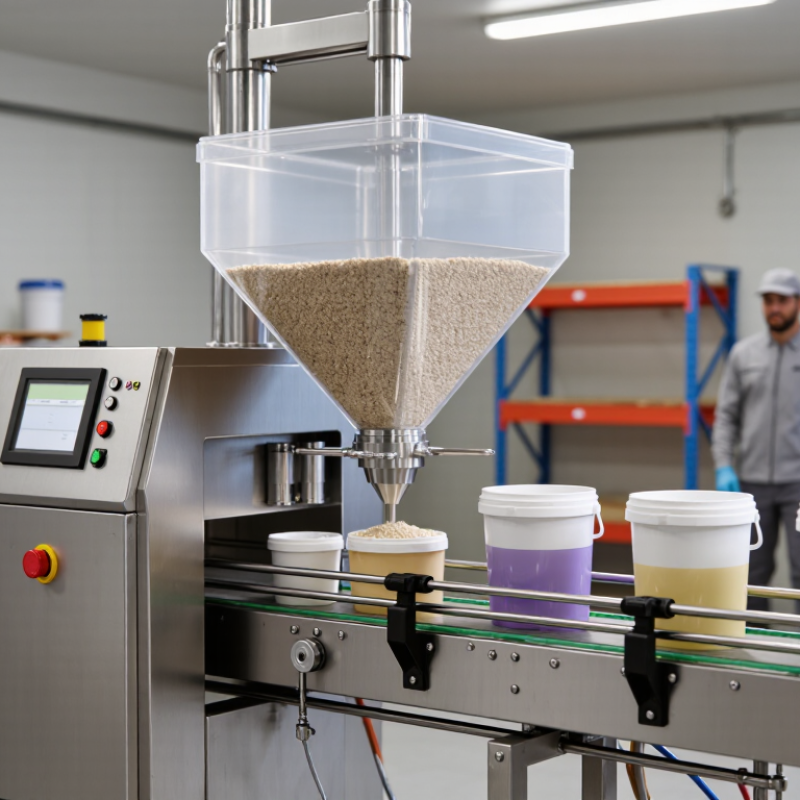
Define Your Bucket Filling Requirements
Choosing a bucket filling machine starts with a clear description of your product, not a machine catalogue. Record product type, bulk density, particle size, moisture, flow behavior, and temperature. Dry granules may fill smoothly. Sticky powder may bridge inside the hopper. Measure each bucket’s target weight and acceptable variation. Also note whether operators change bucket sizes daily. Small details matter. I have seen projects slow down because “standard bucket” meant three different dimensions.
Define output realistically. State buckets per minute, working hours, and planned growth. Include time for cleaning, material changes, weighing checks, and minor stoppages. A line rated at 30 buckets per minute may produce less during routine operation. That gap deserves attention. Describe the feeding method, operator involvement, conveyor layout, and dust-control needs. Check the available floor space, electrical supply, compressed air, and operating environment. These requirements often receive less attention than speed.
Your specification should cover contact materials, cleaning procedures, filling accuracy, controls, guarding, and data records. Ask for test results using your actual product and bucket. Request repeatability data, not only maximum speed. Check adjustment steps with an operator wearing gloves. This sounds basic. It is often overlooked. Leave room for uncertainty because humidity and batch age can change product behavior. A pilot test may reveal problems that no specification sheet shows. Record failures as carefully as successes. That practice makes the final choice more reliable.
Evaluate Filling Accuracy, Speed, and Automation
How to Choose a Bucket Filling Machine?
Filling accuracy should guide your decision, not only the machine’s advertised output. Test several bucket sizes with your actual material. Check the weight after every filling cycle. A small error can become costly across hundreds of buckets. Consider whether the material flows smoothly or forms lumps. Viscosity, moisture, and particle size can change performance. In practical evaluations, repeatability matters as much as the first accurate result. A machine that performs well once may still need adjustment.
Speed also deserves careful measurement. Ask for the sustained filling rate, not the short-term maximum. Observe the complete cycle, including bucket positioning, weighing, filling, and discharge. Automation can reduce labor and improve consistency through sensors, programmable settings, and automatic stoppage. However, excessive automation may create complicated maintenance. Operators should understand the controls and correct simple faults safely. A fast system is not always the most productive choice.
Tips: Compare measured accuracy, cycle time, and changeover time under realistic conditions. Request a trial using your containers and material. Check calibration procedures, cleaning access, and replacement parts before purchase. Leave room for human judgment. Specifications can look impressive, but daily operation may reveal inconvenient details.
Review Maintenance, Safety, and Total Ownership Costs
Choosing a bucket filling machine requires more than checking speed and purchase price. Maintenance access matters every shift. Operators should reach valves, sensors, and product-contact parts without awkward stretching. Tool-free changeover can reduce cleaning delays, but only if parts remain durable after repeated washing.
Safety deserves equal attention. The U.S. Occupational Safety and Health Administration continues to rank machine guarding among its most frequently cited violations. Select equipment with fixed guards, interlocks, emergency stops, and clear lockout points. Risk assessment should follow ISO 12100 principles. Do not accept safety claims without test records. A shiny enclosure proves very little.
Total ownership costs include labor, utilities, spare parts, rejected product, and downtime. Deloitte’s predictive maintenance research reports potential maintenance-cost reductions of 5–10% and downtime reductions of 10–20%, although results vary by application. Compressed-air performance also deserves inspection. The U.S. Department of Energy reports that leaks may waste 20–30% of compressor output. Ask for measured air consumption, not estimates. Build a five-year cost model using realistic production hours and local labor rates. I would also include one uncomfortable assumption: an unplanned weekend repair. Machines rarely fail at convenient times. A careful review may reveal that the cheapest quotation is not the cheapest machine.
How to Choose a Bucket Filling Machine? — Review Maintenance, Safety, and Total Ownership Costs | Machine Configuration | Typical Bucket Size | Typical Output | Filling Accuracy | Product Changeover | Routine Cleaning Time | Recommended Preventive Maintenance | Indicative 5-Year TCO | Safety and Suitability Assessment |
| Manual net-weigh filling station | 5–25 kg | 4–10 buckets/min | ±0.2% to ±0.5% | 10–20 min | 15–30 min | Weekly inspection; monthly scale verification; annual load-cell calibration | US$35,000–90,000 | Lowest capital cost; suitable for low-volume production. Requires operator guarding, ergonomic controls, and dust management. |
| Single-head gross-weigh filler | 5–30 kg | 8–18 buckets/min | ±0.1% to ±0.3% | 15–30 min | 20–40 min | Daily nozzle check; weekly pneumatic inspection; quarterly calibration and seal review | US$70,000–160,000 | Good balance of accuracy and cost. Interlocked access doors, emergency stops, and guarded moving parts are expected. |
| Two-head net-weigh filler | 5–25 kg | 16–32 buckets/min | ±0.1% to ±0.25% | 20–35 min | 25–45 min | Daily inspection; weekly cleaning of weigh hoppers; quarterly calibration; annual replacement review for wear parts | US$120,000–250,000 | Strong choice for medium throughput. Redundant weighing improves productivity, but more valves and sensors increase maintenance requirements. |
| Auger filler for powders | 0.5–25 kg | 10–30 buckets/min | ±0.5% to ±1.0% | 30–60 min | 30–60 min | Daily auger and seal inspection; weekly filter check; monthly drive inspection; quarterly calibration | US$110,000–240,000 | Effective for powders, but dust extraction, grounding, and explosion-risk assessment may be required depending on the material. |
| Volumetric cup or rotary filler | 0.5–20 kg | 20–50 buckets/min | ±1.0% to ±2.0% | 20–40 min | 20–45 min | Daily cup and drive inspection; weekly lubrication check; monthly wear-part review | US$90,000–210,000 | High speed and simple mechanics; less suitable when product density varies or tight weight compliance is required. |
| Automatic weigh filler with conveyor integration | 5–30 kg | 20–45 buckets/min | ±0.1% to ±0.3% | 25–45 min | 30–60 min | Daily sensor and conveyor check; weekly pneumatic inspection; monthly software and reject-system test; quarterly calibration | US$220,000–480,000 | Best for sustained production and reduced labor. Requires coordinated guarding, conveyor safety controls, reject verification, and trained technicians. |
Cost and selection basis: Figures are typical planning ranges in U.S. dollars for new equipment and exclude building modifications, taxes, shipping, installation complexity, and financing. Five-year total ownership cost includes estimated purchase, installation, utilities, preventive maintenance, wear parts, calibration, and operator training. Actual results depend on product flowability, dust level, bucket geometry, production hours, labor rates, and local safety requirements.


